
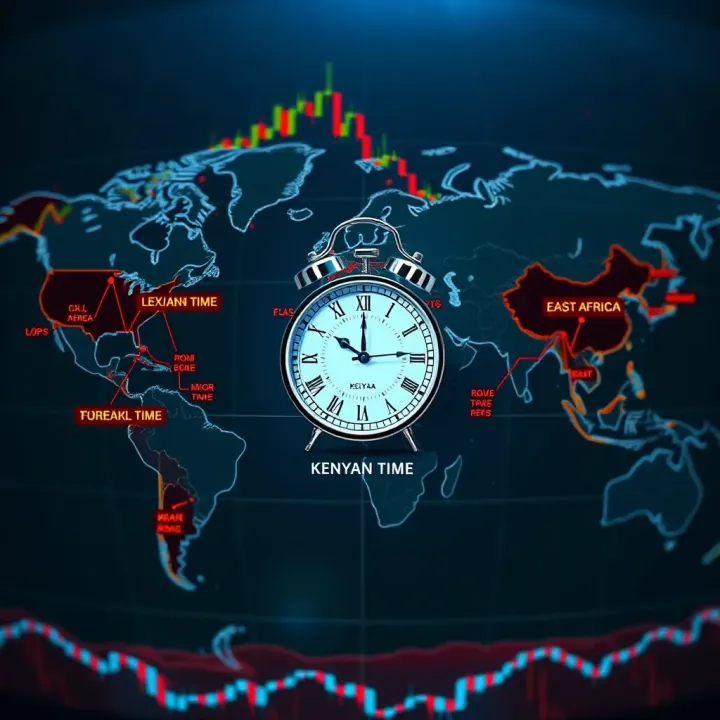
Forex Trading Sessions in Kenyan Time Explained
📈Discover forex trading sessions tailored to Kenyan time (EAT), learn peak hours, overlaps, and profit from market liquidity. Maximise your forex strategy today!
Edited By
Charlotte Davies
Forex trading operates 24 hours a day, but activity varies depending on the trading session. There are four main sessions globally: Sydney, Tokyo, London, and New York. Each happens in different time zones and brings its own market dynamics. For Kenyan traders, understanding how these sessions align with East Africa Time (EAT) helps plan the best moments to engage the market.
Sydney Session (10 pm to 7 am EAT): This starts the trading day but is usually quieter with lower volume. It has a moderate effect on currency pairs like AUD/USD and NZD/USD.
Tokyo Session (12 am to 9 am EAT): With major Asian financial centres active, this session increases volume, especially on JPY, USD/JPY, and other Asian currencies.
London Session (3 pm to 12 am EAT): This session often sees the highest volatility and volume due to London's role as a global financial hub. Major pairs like EUR/USD, GBP/USD witness large price swings.
New York Session (8 pm to 5 am EAT): Overlapping with London in the evening, this session continues high liquidity. News releases from the US often impact market moves heavily here.
When Tokyo overlaps with Sydney, or London overlaps with New York, market liquidity and volatility increase. These overlaps create more trading opportunities but also higher risks. For example, the London-New York overlap is when many major economic reports are released, influencing currency prices sharply.
Knowing the timing and characteristics of these sessions helps Kenyan traders decide when to trade, which pairs to focus on, and how to manage risk effectively.
Plan to trade during London or New York sessions for greater price movements.
Monitor overlaps for higher volatility, which could mean both opportunity and risk.
Focus on currency pairs active in each session: AUD and NZD in Sydney, JPY in Tokyo, GBP and EUR in London, USD-centric pairs in New York.
By aligning trading strategies with the right session, you can better manage market exposure and potentially increase profitability. Understanding these session rhythms is fundamental for any investor or broker serious about forex in Kenya and the wider region.
Understanding forex trading sessions offers a practical edge to anyone active in the currency markets. Market activity shifts with the movement of the sun, influencing liquidity, price movements, and trading opportunities. Kenyan traders benefit by aligning their strategies with these sessions, helping them optimise entry and exit points.
Forex trading runs around the clock due to the earth's rotation, but markets are not equally active all the time. The forex market splits into several sessions based on major financial hubs' working hours. For example, the Asian session runs roughly from 12 am to 9 am East Africa Time (EAT), covering Tokyo and Singapore market hours. Then, the European session takes over from about 9 am to 6 pm EAT, covering London and Frankfurt. Finally, the North American session operates between 3 pm and midnight EAT, focusing on New York.
Adapting to these time zones is crucial. A trader in Nairobi needs to know when each market opens and closes to catch the most liquidity or volatility. Missing these windows can mean trading in thin markets with wider spreads, ultimately costing more.
The forex market's backbone lies in a handful of financial centres. London boasts the biggest share, handling almost 30% of daily forex volumes. Tokyo is key for Asian currencies, while New York dominates the Americas. Singapore and Hong Kong also play vital roles in Asia-Pacific trading.
For Kenyan traders, recognising these centres means identifying when the money flows the most. For instance, the London session often drives moves in pairs like GBP/USD or EUR/KES because of its size and liquidity. When New York overlaps with London, markets tend to be busier and price swings stronger, providing clear chances to exploit short-term trends.
Liquidity — the ease of buying or selling an asset — fluctuates a lot across forex sessions. The European session, especially London hours, sees the highest liquidity given the concentration of banks, hedgers, and speculators. More liquidity means narrower spreads and less slippage, which directly benefits traders by cutting transaction costs.
Conversely, during off-hours like the late Asian session or the early US session, liquidity drops, spreads widen, and execution slows. This can be a headache for traders needing quick fills or tight stops. For example, a Kenyan trader who executes a scalping strategy will do better trading during overlapping periods than when the market sits quietly overnight.
Volatility tends to peak during session overlaps — when two major markets operate simultaneously — and during economic news releases. The London-New York overlap from 4 pm to 6 pm EAT is known for heightened activity. This creates better opportunities for traders but comes with increased risk due to sharper price swings.
On the other hand, volatility can be low during isolated sessions like the early Asian hours, offering calm but fewer chances for profit. Swing traders might prefer these more stable periods to hold positions longer without sudden jolts. Knowing these patterns helps Kenyan traders decide when to trade aggressively and when to hold back.
Matching your trading plan with the active forex session ensures you operate under conditions that suit your style, whether that means chasing rapid moves or holding steady.
Understanding forex trading sessions means timing your moves well — a simple fact that can sharply influence winning chances and risk management in foreign exchange markets.
Understanding the main forex trading sessions is vital for any trader looking to navigate the market effectively. Each session reflects different global financial centres opening and closing at specific times, which influences liquidity, volatility, and price action. Knowing these sessions helps traders time their entries and exits better, avoiding periods of low activity or catching moments of strong market movement.
The Asian session mainly involves markets in Tokyo, Singapore, and Hong Kong, which start trading overnight East Africa Time (EAT). Tokyo dominates this session as it accounts for the largest forex turnover in Asia. While Singapore and Hong Kong are smaller in comparison, their markets contribute to regional liquidity, especially in the Asian currencies.

For Kenyan traders, this session is active roughly from 3 am to 12 pm EAT. Understanding the timing is important for planning trades during quieter hours or for those who prefer early trading.
During the Asian session, trading volume is generally lower than in later sessions, but it focuses on key Asian currencies such as the Japanese yen (JPY), Chinese yuan (CNY), Australian dollar (AUD), and New Zealand dollar (NZD). Pairs like USD/JPY, AUD/USD, and NZD/USD experience the most activity.
Traders interested in commodities-linked currencies like AUD and NZD pay close attention here because economic data from Australia and New Zealand typically releases within this timeframe.
Volatility tends to be subdued during the Asian session compared to the European or American sessions. This means spreads can be wider, but price movements are more predictable. For scalpers or traders relying on quick price swings, the Asian session may seem slow but can offer opportunities when news breaks in the region.
The European session, centred on London, opens around 9 am EAT and is regarded as one of the most influential sessions. London’s role as a global financial hub means huge volumes pass through during these hours.
Kenyan traders tuning in around mid-morning to mid-afternoon EAT see spikes in activity as Europeans join the market. London’s central position also means overlapping with both the Asian and North American sessions at different times, increasing market activity.
The session is marked by high liquidity, tight bid-ask spreads, and dynamic price movements. This combination creates favourable trading conditions, particularly for day traders aiming to capitalise on short-term trends.
Movements during the European session set the tone for the rest of the day. For example, a sudden EUR/USD surge often triggers follow-through momentum in the American session.
Popular pairs for this session include EUR/USD, GBP/USD, USD/CHF, and EUR/GBP. These pairs feature prominently because of London’s proximity to European markets and the US dollar’s prominence.
Traders watch for economic indicators such as Bank of England announcements and Eurozone data that typically emerge during this session, resulting in sharp market reactions.
The North American session, led by New York, opens at 3 pm EAT, coinciding with the tail end of the European session. New York is the second largest forex centre after London, making this session critical for market volatility.
Kenyan traders active in the afternoon and evening tune in to this session for major moves and news releases from the US economy.
The overlap between the New York and European sessions—between 3 pm and 6 pm EAT—sees some of the highest trading volumes and volatility for the day. This period offers tight spreads and numerous trading opportunities due to the combined participation of European and American traders.
This overlap often sees sudden price jumps as news from either continents affects currency pairs, especially those involving USD, EUR, and GBP.
Volatility during the North American session remains high, particularly in the early hours shortly after the opening bell. Currency pairs like USD/CAD, USD/JPY, and EUR/USD often experience big price swings.
For Kenyan traders balancing work and trading, the North American session might be the most practical for live engagement, as it matches local afternoon and evening hours when news and market movement peak.
Remember, understanding these sessions lets you position your trades during the most active hours, improving your chances of capture profitable moves while managing risk effectively.
Timing plays a key role in forex trading, influencing both strategy and outcomes. Traders who understand when different market sessions are active can better align their trading style with market behaviour. For instance, some traders seek high volatility to capitalise on quick price moves, while others prefer steadier periods to plan for longer-term positions.
Scalpers thrive when the market is lively and prices swing quickly. The London-New York session overlap typically sparks this kind of volatility, offering tight spreads and many price swings within short periods. During these hours, trades last just minutes or seconds, demanding fast decisions and immediate execution. Kenyan traders aiming for scalping need to ensure their platforms and internet connections can handle such speed, especially when using mobile funds like M-Pesa for swift account reloads.
Swing traders, on the other hand, prefer times when markets show steadier trends without erratic price spikes. The Asian session, particularly after the Tokyo market opens, tends to feature lower volatility, giving swing traders clearer patterns over several hours or days. This suits traders who can't monitor the markets constantly due to day jobs or other commitments. By focusing on calmer sessions, these traders avoid the stress of rapid price fluctuations and can plan entries and exits more thoughtfully.
When two major sessions overlap, liquidity surges as more participants enter the market. For example, the London-New York overlap sees banks, funds, and retail traders all active, pushing spreads down and making it cheaper to trade. For Kenyan investors, trading during these periods can reduce costs and improve order execution. Liquidity also means large orders trigger smaller price changes, allowing better control over trade entry and exit points.
Trading during session overlaps offers a sweet spot of higher activity and better pricing, which many traders target for efficiency.
Economic reports from the US and Europe often hit during European or North American sessions, stirring sudden price movements. Kenyan traders who watch calendars for releases like US non-farm payrolls or ECB interest rate decisions know to expect volatility spikes. These times bring risks but also opportunities for sharp gains if trades are managed carefully. Besides, news releases often align with session overlaps, compounding market impact and giving alert traders prime chances to profit.
Understanding when the right session and overlap occur, aligned with one’s trading style, is critical. It allows Kenyan traders to use their resources well, whether managing risk during choppy periods or capitalising on rapid moves when liquidity peaks.
Forex trading worldwide follows different sessions according to time zones, and for Kenyan traders, understanding how these sessions fit into East Africa Time (EAT) is vital. The timing directly affects when currency pairs are most active, thus impacting trading opportunities and risks. Being aware of these practical aspects helps you plan your trading around local schedules without missing key market movements.
Forex trading sessions are usually expressed in GMT or local times like New York or London time. Since Kenya uses East Africa Time (EAT), which is GMT+3, converting these times accurately ensures you know exactly when markets open and close. This is particularly important to avoid missing session overlaps that tend to bring higher liquidity and volatility.
Kenya does not observe daylight saving time, unlike some forex centres such as London or New York. During British Summer Time (BST) or US daylight saving periods, the time difference shifts by an hour. For example, when London moves forward by an hour in March, the EAT-to-London difference reduces from 3 to 2 hours. Kenyan traders should adjust their clocks and trade schedules accordingly to catch sessions and news releases at the right time.
For converting session times, you can use tools like the World Clock feature on smartphones or specialised forex time converters available on trusted trading platforms. These tools automatically account for daylight saving switches preventing confusion. Simple spreadsheet calculators or online forex forums can also offer handy reference tables showing forex session times in EAT.
Balancing trading with day-to-day commitments can be tricky, especially during volatile sessions like the London-New York overlap which happens late evening or at night Kenyan time. Traders working regular office hours may find it tough to monitor markets actively during these periods.
To manage this, many Kenyan traders opt for early morning or late evening sessions where they can focus without distraction. Others use stop-loss and take-profit orders to limit risk while away from their screens, allowing them to participate in sessions even with limited time. Swing trading strategies that require less frequent monitoring fit well for busy schedules.
Mobile platforms have revolutionised forex trading in Kenya. Services like Safaricom's M-Pesa make it easy to fund accounts quickly and securely from almost anywhere. This means if you spot a market opportunity after hours, you can fund your account and trade immediately without visiting a bank or physical agent.
Using mobile payments helps overcome traditional barriers, especially for traders outside Nairobi or other major centres. Quick deposits and withdrawals translate into better control over trading funds and faster reaction to market changes.
In summary, being practical about session timing and incorporating mobile payment options go a long way in helping Kenyan forex traders navigate the often fast-moving currency markets while fitting trading into their daily lives.
Understanding forex trading sessions is essential for any trader aiming to maximise profits and manage risks effectively. Each trading session—from Asian to European to North American—brings specific characteristics that influence market behaviour, liquidity, and volatility. This section summarises these key features and highlights how Kenyan traders can use this knowledge to their advantage.
Forex sessions operate according to major financial hubs across the globe. The Asian session, running primarily during Tokyo’s business hours, is marked by lower volatility and liquidity compared to other sessions, making it favourable for traders who prefer steadier price movements. Popular currency pairs during this period include USD/JPY and AUD/USD.
The European session, centred in London, sees a sharp increase in market activity. This session often features high liquidity and wider price swings, driven by substantial economic data releases from the UK and Europe. Currency pairs like GBP/USD and EUR/USD are heavily traded, attracting scalpers and day traders looking for fast movement.
Lastly, the North American session, led by New York, overlaps partially with the European session, creating a period of intensified activity and tighter spreads. This overlap, especially between 3 pm and 5 pm EAT, sees sharp price volatility, often creating prime opportunities for swing and position traders. USD/CAD and USD/MXN feature prominently during these hours.
Knowing these session traits helps traders anticipate when markets will be active or quiet, assisting in planning entries and managing stops.
Using session information strategically can directly improve trading outcomes. For instance, Kenyan traders balancing day jobs might focus on the Asian session, which aligns better with early morning or late-night trading, often requiring less monitoring due to its lower volatility.
Alternatively, traders seeking higher activity and quick moves might target the European or North American sessions, especially during the overlapping hours. This timing can capitalise on increased liquidity and tighter spreads, which usually means reduced transaction costs.
Practical tools like session timers and economic calendars tailored to East Africa Time (EAT) enable traders to sync their strategies with these sessions effortlessly. For example, monitoring GBP and EUR news releases during the European session alerts traders to potential market-moving events.
Ultimately, blending session awareness with personal trading style, risk tolerance, and economic event knowledge equips traders to enter the market with clearer expectations. This approach reduces guesswork and promotes disciplined trading behaviour, which is vital for sustainable profits.
In summary, understanding forex trading sessions and their unique impacts provides Kenyan traders with a clear roadmap to navigate the global forex market more confidently. Using this knowledge smartly enhances timing and decision-making, helping to seize opportunities and avoid unnecessary exposure to volatile, less predictable markets.
📈Discover forex trading sessions tailored to Kenyan time (EAT), learn peak hours, overlaps, and profit from market liquidity. Maximise your forex strategy today!
📈 Learn how forex trading sessions impact currency markets and volatility. Find the best times to trade from Nairobi and tips fitting Kenyan trading routines.

📈 Discover how forex trading began centuries ago, evolving from simple currency swaps to Kenya's vibrant, tech-driven market today. Learn the history behind this global financial hub.
Learn forex trading step by step with easy guides on market basics, proven strategies, risk control, and practical tools to boost your skills 📈 Start trading confidently today!
Based on 7 reviews